 By:
By: Students will spend hours struggling through difficult problems in games voluntarily.
My own daughter is replaying a zombie game called The Last of Us on Survivor mode after already beating it on easier settings.
No one assigned it.
No one gave her a grade.
No one promised a badge.
She is choosing to make the experience harder.
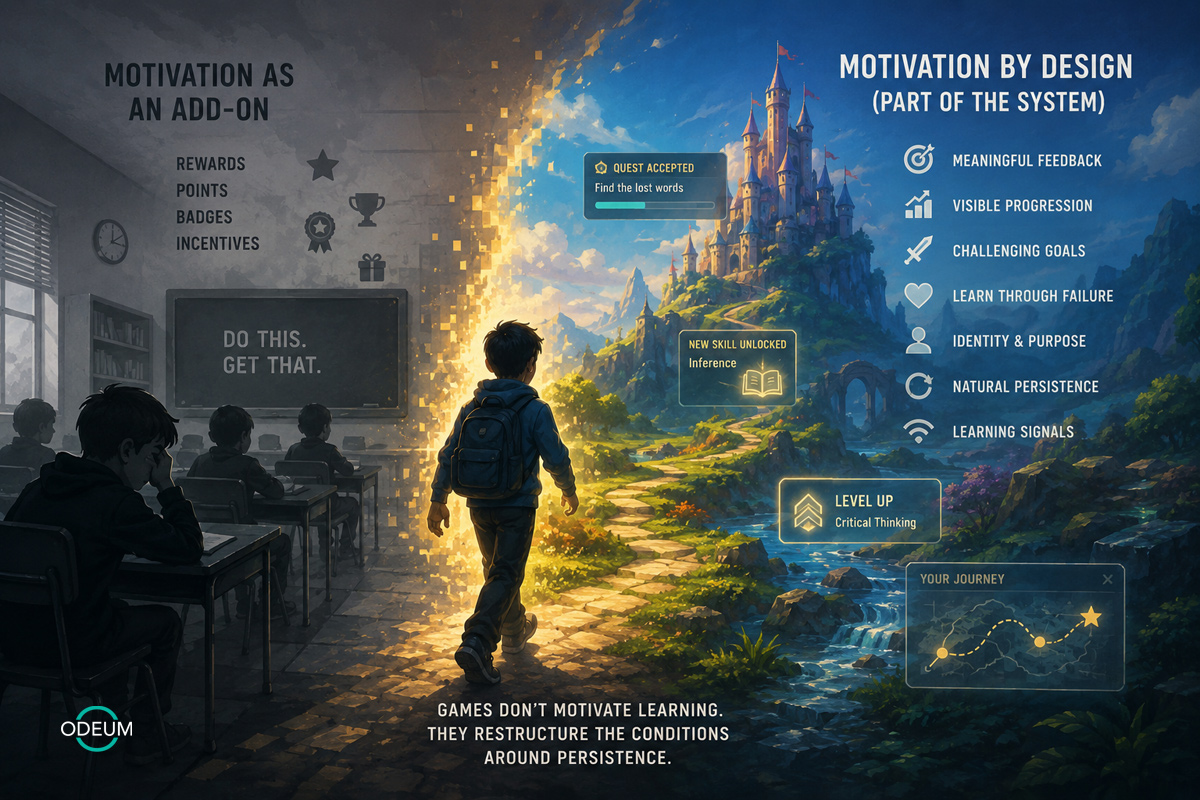
That choice is worth paying attention to because it reveals something schools often miss about motivation. We tend to treat motivation as separate from learning. We design the lesson, then add rewards, points, grades, badges, or incentives to encourage students to complete it.
Games don’t work that way.
Games integrate feedback, identity, progression, challenge, meaning, and persistence into one coherent system. The motivation is not layered on top. It is built into the structure of the experience.
That is why games do not simply “motivate” learning.
They restructure the conditions around persistence.
Motivation Is Usually Treated as an Add-On
In many learning environments, motivation is treated as a separate layer.
A lesson is designed. Then points are added.
A worksheet is assigned. Then a reward appears.
A student completes a task. Then a badge tries to make the task feel more appealing.
There is nothing inherently wrong with rewards or incentives. They can help in certain contexts. But they often sit outside the learning experience. They tell the student, “Do this thing, and something else will happen.”
Games work differently.
In The Last of Us, my daughter is not replaying on Survivor mode because the game added a superficial reward system. She is replaying because the game has already built a meaningful relationship between effort, skill, tension, and progress.
The first time through, the game gave her enough support to learn the basics. She had more ammo. More room for error. More obvious ways to survive a level.
Now, on Survivor mode, the same kind of scenario changes. She may enter an encounter with little or no ammo. A direct approach no longer works. She has to observe enemy movement, use the environment, conserve resources, lure infected toward hostile enemies, and experiment with strategies that were unnecessary at lower difficulty levels.
The game has not changed the learning goal in a shallow way.
It has changed the conditions around mastery.
That is the difference between motivation as an add-on and motivation as architecture.
When motivation is added after the fact, students may comply. When motivation is structurally embedded, students begin to care about the work itself.
This is the mistake I see often in education technology as well. We take an academic activity and ask, “How do we make this more engaging?” But the deeper question is, “How should the system be designed so that effort, feedback, identity, and meaning are inseparable from learning?”
That is where games become more than decoration.
They become learning systems.
Games Normalize Productive Failure
One of the most important things games do is change the meaning of failure.
Players fail constantly.
They lose encounters.
They choose the wrong strategy.
They run out of resources.
They get spotted.
They restart.
They try again.
In many games, failure is not a final judgment. It is information.
When my daughter fails a section in Survivor mode, the game is not telling her, “You are bad at this.” It is telling her something more specific:
That path is too exposed.
That enemy pattern matters.
That resource should have been saved.
That distraction worked, but the timing was wrong.
That encounter has another solution.
The failure gives her something to think about.
School often sends a different signal.
A wrong answer can feel like a public marker of ability. A low score can feel like identity. A mistake can become evidence that a student is “not good at math,” “not a strong reader,” or “not trying hard enough.”
The academic task may actually be simpler than the game challenge. But emotionally, it is riskier.
That is one reason students may persist through difficult game problems while disengaging from academically easier tasks. The issue is not always difficulty. Often, it is the emotional structure surrounding difficulty.
Games create a safer loop:
Try.
Fail.
Learn.
Adjust.
Try again.
The loop is fast, contextual, and usually private enough for experimentation.
That does not mean games remove frustration. They do something more useful: they make frustration feel navigable.
A student who believes failure is evidence of permanent ability will avoid challenge. A student who believes failure is part of the path can stay in motion longer.
Motivation grows when struggle has a place to go.
Scaffolding Becomes Part of the Experience
The Survivor mode example also shows something important about scaffolding.
My daughter did not start there.
She first played through the game on easier modes, where the system gave her more support. She could learn the controls, the pacing, the enemy types, the resource system, and the basic survival strategies in a more forgiving context.
Then she chose to return at a higher difficulty.
Now the game asks for deeper understanding.
It is no longer enough to know how to aim, hide, craft, or move through a space. She has to understand when to avoid conflict, when to use scarce resources, how to manipulate enemy behavior, and how to adapt when the obvious solution is unavailable.
That is learning transfer.
In school, we often talk about transfer as one of the hardest parts of learning. Can a student apply what they know in a new context? Can they adjust when the conditions change? Can they persist when the first strategy fails?
Games make that kind of transfer inherent in the design.
They do not simply ask the learner to repeat the same skill under the same conditions. They change the environment. They introduce constraints. They force strategies to evolve.
This is one of the reasons game-based learning has so much potential when designed seriously.
A strong game-based learning environment can let students first build confidence in a supported context, then apply those same skills under new conditions. The learning becomes less about recalling the right answer and more about adapting knowledge to a meaningful situation.
That is where mastery becomes visible.
Not because the learner completed the same task ten times.
Because the learner can act intelligently when the situation changes.
Identity Changes Effort
Games also change who the learner becomes inside the task.
A player is not merely solving a mechanical problem. They are surviving, exploring, investigating, building, protecting, leading, or strategizing.
That identity changes effort.
In The Last of Us, my daughter is not just pressing buttons in the correct sequence. She is inhabiting a role inside a dangerous world. The constraints matter because the world matters. The limited ammo matters because survival matters. The failed attempt matters because she believes there is a way through the encounter if she understands the system better.
That belief changes the emotional meaning of persistence.
In a classroom, a student might be asked to complete a sequence of reading comprehension questions. In a game-based learning environment, that same learner might become a detective interpreting clues, a traveler decoding messages, or a strategist making decisions with consequences.
The underlying skill may be similar.
But the learner’s relationship to the skill changes.
This is one of the reasons I have been drawn to quest-based learning systems. In designing Odeum, I keep returning to the same idea: narrative gives effort a place to live.
When learners move through a world with purpose, stakes, and identity, the task is no longer isolated. It becomes part of a larger journey.
This is also where gamification often falls short.
If we only add points to a task, the learner’s identity may not change. They are still a student completing an assignment. But if the system gives them a meaningful role, the same skill practice can become part of a larger arc.
Identity is not cosmetic.
It shapes what struggle means.
A detective expects confusion.
A strategist expects failed attempts.
An explorer expects uncertainty.
A survivor expects constraints.
In that context, difficulty does not automatically signal inadequacy.
It signals that the journey is real.
Progression Makes Effort Visible
Another reason games support motivation so naturally is that they make progress visible.
Players can usually tell where they are, what has changed, and what might come next.
They know they have improved because the same challenge feels different now. They can access new areas. They can use new tools. They can defeat enemies they previously avoided. They can take on harder missions with greater confidence.
In my daughter’s case, replaying on Survivor mode only makes sense because she can feel the progression from her earlier playthroughs.
She knows the game.
She knows the patterns.
She knows the systems.
She knows there is a solution.
That prior success gives her enough confidence to face a harder version of the same world.
In school, progress is often less visible.
Students may complete many tasks without a clear sense of how their capability is changing. Feedback may arrive too late. Grades may summarize performance without showing growth. A student may be working hard but still feel stuck because the system does not reveal the movement underneath.
Games are powerful because they externalize growth.
They turn invisible development into perceivable change.
This matters for motivation because effort without visible progress becomes exhausting. Students need to see that their actions are accumulating into something. Not in a shallow “level up” sense, but in a meaningful capability sense.
The best learning systems should help students feel:
“I could not do this before.”
“I am starting to understand the pattern.”
“I have a next move.”
“My effort is changing what I can do.”
That is motivational architecture.
Games Generate Learning Signals Without Breaking Flow
Games are also unusually good at producing learning signals.
A player’s choices reveal strategy. Repeated attempts reveal persistence. Hesitation can reveal uncertainty. Tool selection can reveal understanding. Path choices can reveal confidence, curiosity, or avoidance. Patterns of failure can reveal a misconception more clearly than a single quiz item.
In the Survivor mode example, the game could learn a great deal from how my daughter plays.
Does she conserve resources?
Does she rely on stealth or direct confrontation?
Does she notice environmental affordances?
Does she repeat the same failed strategy or adapt?
Does she understand how one system can influence another?
Those are rich signals.
And they emerge through play.
This is one of the most important bridges between game-based learning and adaptive learning.
Traditional assessment often interrupts the learning flow. The student stops doing the meaningful activity and enters an evaluation moment. The system asks, “Did you learn it?”
Games allow something different.
They can observe learning through action.
That does not mean every click should become a data point or every behavior should be over-interpreted. We should be careful not to turn learners into labels. A pattern of behavior may suggest that a student needs more support with planning, memory, sequencing, or persistence in a particular activity. But that does not justify diagnosing or categorizing the student.
The signal should help the system adapt the experience.
It should not reduce the learner to a fixed identity.
Used responsibly, however, game environments can generate rich learning signals without asking students or teachers to stop the work.
This connects directly to classroom flow.
In a classroom, every interruption has a cost. Teachers are managing attention, pacing, emotion, behavior, and instruction in real time. A tool that requires constant manual data entry may technically capture information, but it can damage the flow it is supposed to support.
Games offer a different model: the learning environment itself can become the signal engine.
The student keeps playing.
The teacher keeps teaching.
The system learns from meaningful action.
That is a much more natural foundation for personalization.
The Real Lesson Is Structural
The lesson from games is not that every classroom should look like a commercial video game.
It is not that every lesson needs zombies, avatars, coins, leaderboards, or fantasy worlds.
The deeper lesson is structural.
Games solve motivation by aligning the parts of the experience that schools often separate:
Feedback is immediate.
Progress is visible.
Challenge is calibrated.
Failure is expected.
Identity is meaningful.
Effort changes what is possible.
Signals emerge through action.
That alignment is what makes persistence feel natural.
When students disengage from school, it is easy to assume they lack motivation. Sometimes that may be true in a surface sense. But often, the system has failed to create the conditions where motivation can emerge.
Watching my daughter replay The Last of Us on a harder mode reminds me that learners will choose challenge when the system has prepared them for it, when progress is visible, and when failure feels like information rather than judgment.
That is the design lesson education should take seriously.
The question is not, “How do we make students care?”
The better question is, “What kind of learning environment makes effort feel meaningful, progress feel visible, and struggle feel worth continuing?”
Games have been answering that question for decades.
Education does not need to copy games superficially. It needs to understand why they work.
For me, this is where game-based learning, AI personalization, cognitive design, and adaptive pathways converge.
A strong learning system should not bolt motivation on at the end. It should be designed so that motivation, mastery, and meaning reinforce one another from the beginning.
That is the promise of games in education.
Not entertainment as a distraction from learning.
Learning designed as a system students want to stay inside.